
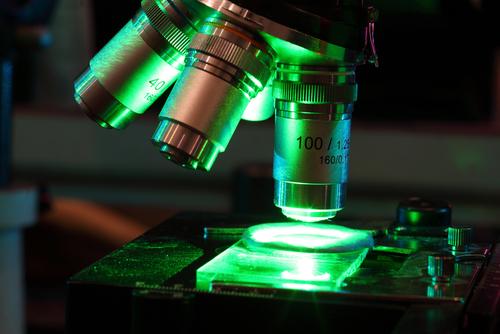
Yale University recently developed an innovative semiconductor laser that has the prospective to improve the quality of images of multiple advanced microscopes and other biomedical imaging. The prototype was supported by a cavity laser, which joins together the brightness of customary lasers and matches them with the lower image corruption of LED's to produce a powerful emission.
This project was a collaboration between multiple Yale labs and departments as well as scientists that are involved in applied physics, diagnostic radiology, electrical and biomedical engineering. Douglas Stone, who is a professor of physics and chair of applied physics at Carl A. Morse stated that "This chaotic cavity laser is a great example of basic research ultimately leading to a potentially important invention for the social good." The work that was conducted on the laser was based on a set of principles of these lasers and their applications.
One issue in the imaging of microscopy is identified as "speckle." Speckle is a "random, grainy pattern, caused by high spatial coherence that can corrupt the formation of images when traditional lasers are used." A solution is to possibly use LED's, but they fall short due to high-speed imaging. Want to know more about this microscopy laser? Read more about the semiconductor laser at Engineering.Com.
More post in same category
- Product Feature: Glutaraldehyde, 70% Aqueous - EM Grade
- Product Feature: Classic Floor Model LADD Vacuum Evaporator
- Product Feature: Focused Ion Beam
- We're Attending the Microscopy & Microanalysis 2015 Meeting In Portland, Oregon This August
- A Recent Development In Electrocatalysts Is Proving To Be Both Effective & Inexpensive
- Yale Develops New Semiconductor Laser To Improve Imaging Quality For Microscopy



Leave a comment
0 Comments